記事のポイント3行まとめ
- 中国の食事関連がん負担は世界より速く減るが、若年層は増加傾向。
- 赤肉過剰摂取は女性、全粒穀物不足は男性に最もリスク高い。
- 2036年、中国の負担は世界平均より低く、公衆衛生対策が重要。
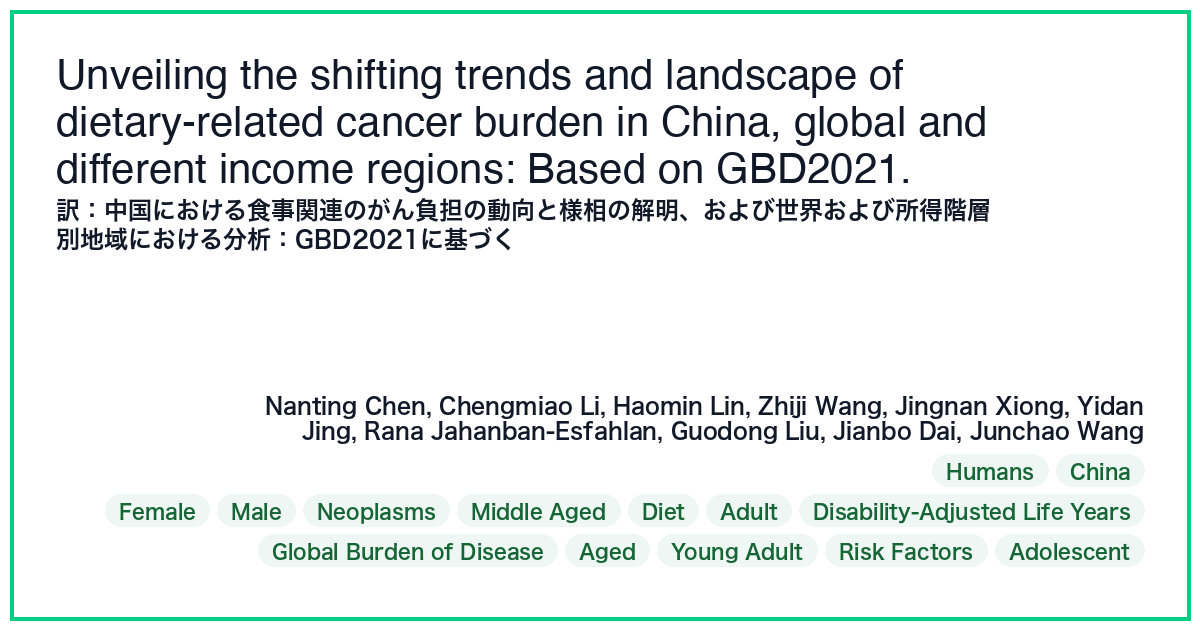
| タイトル(原文) | Unveiling the shifting trends and landscape of dietary-related cancer burden in China, global and different income regions: Based on GBD2021. |
|---|---|
| タイトル(日本語) | 中国における食事関連のがん負担の動向と様相の解明、および世界および所得階層別地域における分析:GBD2021に基づく |
| 著者情報 | Nanting Chen, Chengmiao Li, Haomin Lin, Zhiji Wang, Jingnan Xiong, Yidan Jing, Rana Jahanban-Esfahlan, Guodong Liu, Jianbo Dai, Junchao Wang Department of General Surgery, Nan’an District People’s Hospital, Chongqing, China. Department of General Surgery, Nan’an District People’s Hospital, Chongqing, China. Electronic address: 604487192@qq.com. Department of General Surgery, Nan’an District People’s Hospital, Chongqing, China. Electronic address: 768926718@qq.com. Department of Hepatobiliary Pancreatic Surgery, Chengdu Sixth People’s Hospital, Jianshe South Road No.16, Sichuan, China. Department of Medical Biotechnology, Faculty of Advanced Medical Sciences, Tabriz University of Medical Sciences, Tabriz, Iran. Department of Neurosurgery, Second Affiliated Hospital, Chongqing Medical University, Chongqing, China. Electronic address: 304678@hospital.cqmu.edu.cn. The Second Affiliated Hospital, Chongqing Medical University, Chongqing, China. Wuxi School of Medcine, Jiangnan University, Nangjing, China. |
| ジャーナル等 | Cancer epidemiology 98; 102911 |
| DOI | 10.1016/j.canep.2025.102911 |
| MeSHタグ | Humans China Female Male Neoplasms Middle Aged Diet Adult Disability-Adjusted Life Years Global Burden of Disease Aged Young Adult Risk Factors Adolescent |
| 出版日 | 2025/Oct |
| リンク | PubMedページ | Publisherページ |
日本語アブストラクト
本研究では、1990年から2021年にかけて中国における食事関連リスク起因がん(DRAC)の負担を評価し、世界的な動向および社会人口指数(SDI)地域別の傾向と比較しました。さらに、2036年までの将来的な推移を予測しました。本研究は、Global Burden of Disease 2021に基づき、年齢調整後障害生存年数(ASDR)および年齢調整後死亡率(ASMR)を用いてDRACを評価しました。経年変化は、年変化率(APC)および推定年変化率(EAPC)を用いて評価しました。主要な要因は、分解分析および年齢・期間・コホート分析を通じて特定され、将来の傾向はベイズ統計を用いた年齢・期間・コホートモデルを用いて予測されました。1990年から2021年にかけて、ほとんどの国で全人口のASDRおよびASMRにおいてEAPC値はマイナスを示し、特に中国ではその傾向が顕著でした(-2.9、-2.7)。しかしながら、約2013年以降、中国および中SDI地域における若年成人(55歳未満)のASDRおよびASMRのAPC値はプラスに転じています。性別を見ると、中国全土でDRACのASDRおよびASMRは、男性の方が女性よりも一貫して高くなっています。具体的には、赤肉を多く含む食事および全粒穀物を十分に摂取しない食事は、それぞれ女性および男性にとって最も高い食事関連がんリスクをもたらしました。予測では、2036年までに中国のDRACのASDRおよびASMRはそれぞれ約200および8に低下する可能性があり、世界的な数値はそれぞれ約180および7(10万人あたり)まで低下する可能性があります。1990年から2021年にかけて中国のDRAC負担全体は世界的に見ても特に速いペースで減少しましたが、予測によると2036年時点でも世界平均を上回る見込みです。注目すべきは、2013年以降、中国および中SDI地域の両方で若年成人における食事関連リスク起因がんの負担が増加していることが観察されている点です。性別間でも、異なる負担プロファイルとリスク因子の分布が観察されました。将来的には、年齢、性別、および主要な食事関連リスクに合わせた、的を絞った公衆衛生政策の策定と実施が必要です。
英語アブストラクト
This study assessed the burden of dietary risk-attributed cancers (DRAC) in China from 1990 to 2021, comparing trends with global patterns and across sociodemographic index (SDI) regions. We further projected future trajectories up to 2036. The study assesses DRAC using age-standardized disability-adjusted life-years rates (ASDR) and age-standardized mortality rates (ASMR) based on Global Burden of Disease 2021. Temporal trends were evaluated using annual percentage change (APC) and estimated annual percentage change (EAPC). Key drivers were identified through decomposition and age-period-cohort analyses, while future trends were projected using a Bayesian age-period-cohort model. From 1990 to 2021, most countries exhibited negative EAPC values for overall population ASDR and ASMR, especially in China (-2.9; – 2.7). However, since approximately 2013, APC values for ASDR and ASMR among younger adults (under 55 years) in China and middle SDI regions have been positive. As for sexes, the ASDR and ASMR for DRAC were consistently higher in males than in females across China. Specifically, a diet rich in red meat and diet deficient in whole grains posed the highest dietary cancer risk for females and males respectively. Projections suggest that by 2036, China’s ASDR and ASMR for DRAC may decrease to about 200 and 8, while global figures could drop to about 180 and 7 per 100,000. Although China’s overall DRAC burden declined particularly fast on a global scale from 1990 to 2021, projections indicate it will remain above the global average by 2036. Notably, since 2013, both China and middle SDI regions have witnessed a rising burden of dietary risk-attributed cancers among young adults. Distinct burden profiles and risk factor distributions have been observed between genders. Targeted public health policies tailored to age, sex, and leading dietary risks should be formulated and implemented in the future.



コメント