記事のポイント3行まとめ
- 稀少がんは診断・治療・予後で課題が多く、プレシジョン・オンコロジー導入にも障壁がある。
- ゲノムプロファイリング、臨床試験・治療へのアクセス迅速化、データ収集には協調的取り組みが必要。
- 患者団体、臨床試験組織、資金提供者の役割拡大と、革新的な解決策によるアンメットニーズへの対応が急務。
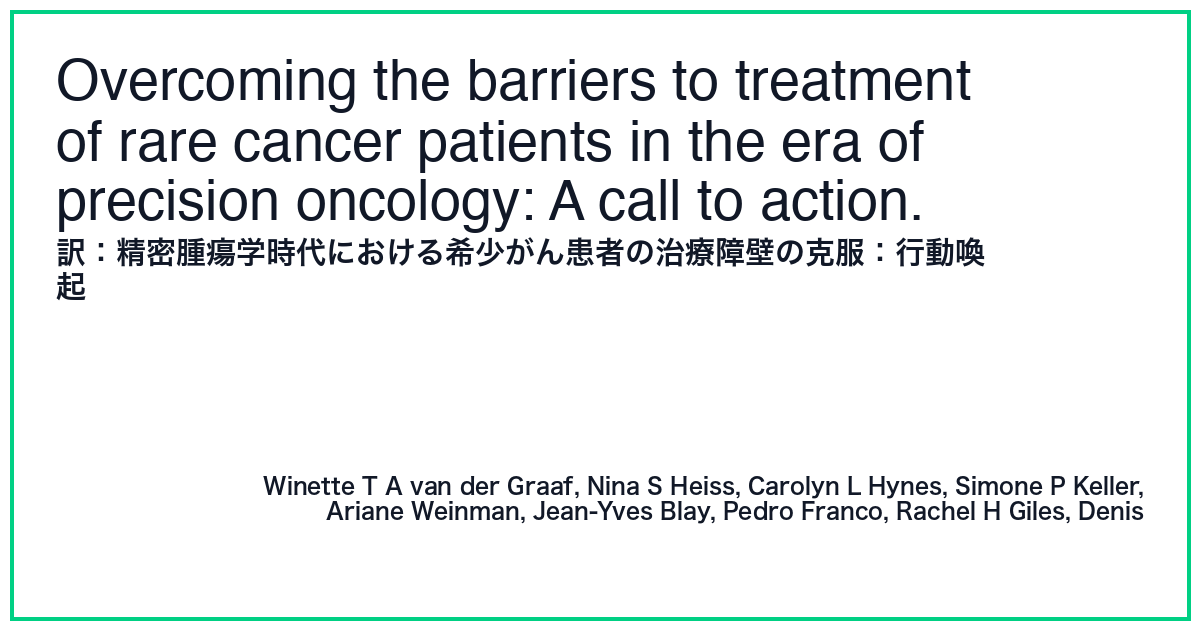
| タイトル(原文) | Overcoming the barriers to treatment of rare cancer patients in the era of precision oncology: A call to action. |
|---|---|
| タイトル(日本語) | 精密腫瘍学時代における希少がん患者の治療障壁の克服:行動喚起 |
| 著者情報 | Winette T A van der Graaf, Nina S Heiss, Carolyn L Hynes, Simone P Keller, Ariane Weinman, Jean-Yves Blay, Pedro Franco, Rachel H Giles, Denis Lacombe, Philipp Schlatter, David M Thomas, Sahar Barjesteh van Waalwijk van Doorn-Khosrovani, Max Williamson, Ruth Plummer Bristol Myers Squibb, Route de Perreux 1, 2017 Boudry, Switzerland. Electronic address: simone.keller@bms.com. CZ Health Insurance, Ringbaan West 236, 5038 KE Tilburg, Netherlands; Department of Medical Oncology, Leiden University Medical Centre, Albinusdreef 2, 2333 ZA Leiden, Netherlands. Electronic address: sahar.van.Waalwijk@cz.nl. Centre Léon Bérard & Université Claude Bernard Lyon I, 28 Rue Laënnec, 69008 Lyon, France. Electronic address: jean-yves.blay@lyon.unicancer.fr. Centre for Molecular Oncology, University of New South Wales, Sydney 2052, Australia. Electronic address: dmthomas@unsw.edu.au. Department of Medical Oncology, Netherlands Cancer Institute, Plesmanlaan 121, 1066 CX Amsterdam, Netherlands; Department of Medical Oncology, Erasmus MC Cancer Institute, Erasmus Medical Center, Dr. Molewaterplein 40, 3015 GD Rotterdam, Netherlands. Electronic address: w.t.a.vandergraaf@erasmusmc.nl. EURORDIS-Rare Diseases Europe, Plateforme Maladies Rares, 96, rue Didot, 75014 Paris, France. Electronic address: ariane.weinman@eurordis.org. European Organisation for Research and Treatment of Cancer (EORTC), Avenue E. Mounier 83, 1200 Bruxelles, Belgium. Electronic address: denis.lacombe@eortc.org. Global Medical Affairs, F. Hoffmann-La Roche Ltd., Grenzacherstrasse 124, 4070 Basel, Switzerland. Electronic address: philipp.schlatter@roche.com. Global Regulatory Affairs & Scientific Policy, Merck KGaA, Frankfurter Street 250, 64293 Darmstadt, Germany. Electronic address: Nina.Heiss@merckgroup.com. Global Regulatory Affairs & Scientific Policy, Merck KGaA, Frankfurter Street 250, 64293 Darmstadt, Germany. Electronic address: pedro.franco@merckgroup.com. Oncology Regulatory Science & Strategy, AstraZeneca, 126-130 Hills Road, Cambridge CB2 1PQ, UK. Electronic address: carolyn.hynes@astrazeneca.com. Patvocates GmbH, Am Rothenanger 1b, 85521 Riemerling, Germany. Electronic address: rachel.giles@patvocates.net. School of Medicine, Dentistry and Nursing, University of Glasgow, University Avenue, Glasgow G12 8QQ, UK. Translational and Clinical Research Institute, Newcastle University, Newcastle upon Tyne NE2 4HH, UK. Electronic address: Ruth.Plummer@newcastle.ac.uk. |
| ジャーナル等 | Cancer treatment reviews 140; 103013 |
| DOI | 10.1016/j.ctrv.2025.103013 |
| MeSHタグ | |
| 出版日 | 2025/Aug/14 |
| リンク | PubMedページ | Publisherページ |
日本語アブストラクト
稀少がんが欧州のがん診断の4分の1を占めているにもかかわらず、臨床研究、診断、治療へのアクセス、生存予後は、一般的ながんに比べて著しく遅れをとっています。プレシジョン・オンコロジー(精密腫瘍学)の可能性は大きいものの、この集団における包括的なゲノムプロファイリングの日常臨床実践への一貫した導入と、堅牢なエビデンス創出は依然として課題であり、規制上の障壁と医薬品開発への投資不足によってさらに複雑化しています。診断の最適化、特に分子プロファイリングへのアクセス向上、臨床試験と治療へのアクセスの迅速化、そして患者報告アウトカムを含む質の高いデータの収集には、すべてのステークホルダーによる協調的な取り組みが必要です。すでに有望な兆候として、国立専門家参照センターやEURACANのような欧州参照ネットワークの設立など、いくつかの取り組みがあります。しかし、診断の軌道を速め、稀少がん患者がより進行期の遅い段階で受診できるようにし、安全で効果的であることが示されたプレシジョン・オンコロジー薬へのより広範なアクセスを促進するためには、さらなる協力が必要です。診断、治療、研究、開発、規制といった多くの障壁が存在する状況下では、前述のギャップを埋めるために、患者団体、臨床試験組織、および資金提供者の役割はさらに大きくなります。稀少がん患者の高いアンメットメディカルニーズに対処するためには、革新的な解決策が緊急に求められています。
英語アブストラクト
Rare cancers account for a quarter of cancer diagnoses in Europe yet clinical research, diagnosis, treatment access, and survival outcomes lag significantly behind common cancers. Despite the potential of precision oncology, the consistent implementation of comprehensive genomic profiling in routine clinical practice and robust evidence-generation remains a challenge in this population, compounded by regulatory hurdles and a lack of investment in drug development. A concerted effort across all stakeholders is required to optimise diagnostics, including access to molecular profiling, to expedite clinical trials and treatment access, and to gather high-quality data, including patient-reported outcomes, in rare cancers. Some initiatives are already showing promise including the establishment of national expert reference centres and European Reference Networks such as EURACAN. However, further collaboration is required to speed up the diagnostic trajectory so that rare cancer patients present with less late-stage disease, and to facilitate clinical trials leading to wider access to precision oncology drugs shown to be safe and effective. In the context of so many hurdles (diagnosis, treatment, research, development and regulatory), there is an even greater role for patient and clinical trial organisations and funders to help fill the aforementioned gaps. Innovative solutions are urgently required to address the high unmet medical need for patients with rare cancers.



コメント